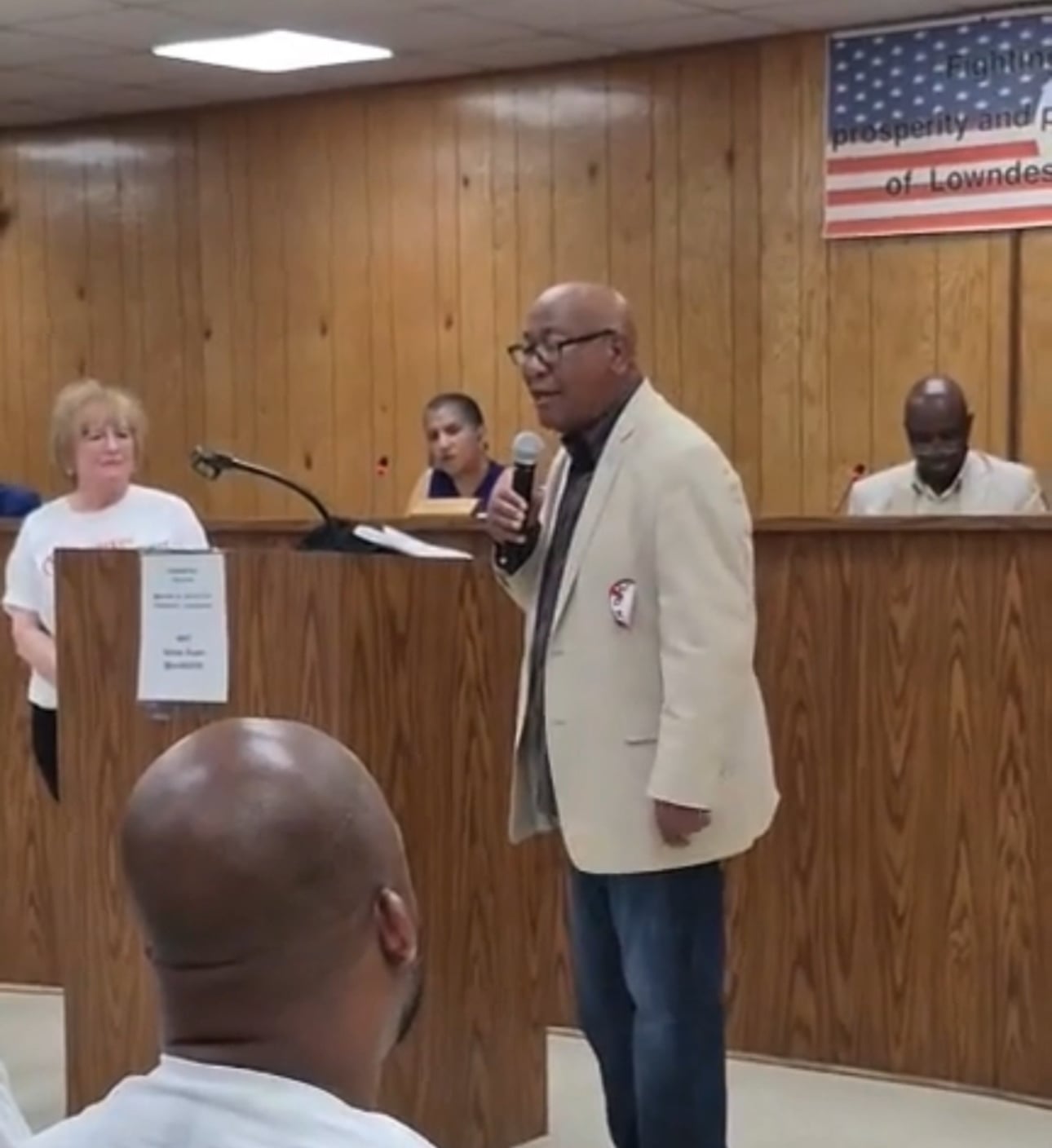
Reverend Pastor Tom Garner did not plan to speak. When he did, he delivered the case in a sentence: the developer is just like a man who built a house, and he does not know who is going to live in it. His property abuts the proposed Project Red Clay parcel.
The man who gave away his time.
Ann McCurdy of Lowndesboro had a place on the May 26 docket. She gave it away. She stood, said she had plenty she could say about where she stood, and then deferred her time to Reverend Pastor Tom Garner, who told the Commission he had not planned to speak at all.1 He opened with something practical: he offered the county the Wellness Center on Highway 37, a room that holds about four hundred people, as a place to finally hold the public meeting residents had been asking for. Then he made the case.
A sheet of paper.
Garner does not live near the proposed data center. He lives on its line. “They told me that I live next door to the data center,” he said. “The data center, my property and this property, a sheet of paper could go between the two of it.” The survey was already done: “The strings are tied on my back fence in my backyard.”2 He built his home there fifteen to twenty years ago, on purpose, because he wanted to come back to Lowndes County and wanted his children to know where Lowndes County was.
The campus described to residents runs to roughly five million square feet.3 By the Commission's own account, relayed from the dais that night, it would sit in the midst of 250-plus houses and the families inside them.4
“Most of what you told us wasn't true.”
Garner said his study of the project had been done mostly through reading, because the answers were not coming from the county. “Most of the things that you've told us,” he said, “I found out it wasn't true.”5 The promise that stung most was property value. He had been told prices would go up. He watched them go down.
The single study most often cited to reassure residents, from George Mason University's Schar School, did find that homes near data centers in Northern Virginia sold for more, not less. But its own authors cautioned that the result may reflect that region's acute housing shortage and may not carry over to a rural market like Lowndes.6 Garner's point was the lived one: home ownership is how a family is supposed to improve its life and leave the next generation a paid-off home, and the houses around the parcel are barely two decades old, not yet passed through a single family.
A man who built a house.
Then Garner described the developer in a single sentence the coalition has spent months trying to say. “The developer is just like a man who built a house,” he said. “He don't know who's going to live in it.”7 That is the unnamed tenant, in plain language. Cloverleaf Infrastructure assembles land and power and sells the finished package to a hyperscale operator; it does not own or run the data center, and it has named no company that would.8
Garner had read about the places that said yes first. In Virginia, the state has had to invent a new electricity rate class to keep data-center load from landing on residents' power bills.9 There, residents near hyperscale campuses describe headaches, sleep loss, and worse10, and researchers modeling the buildout project thousands of premature deaths and billions of dollars in public-health costs by 2030.11 “It's enough open land in the United States of America to put a data center,” Garner said. His question was why this one had to go in the middle of his neighbors.
“Don't give up.”
Garner did not close with a demand. He closed with an instruction to the room. “I'm gonna tell you, don't give up,” he said. “Don't give up.” If the people stayed together, he said, something would happen, and it would be the right thing for Lowndes County. He gave his time back having never planned to use it, and having said the quiet part plainly: a county is being asked to live behind a building whose owner has not been named, close enough that a sheet of paper would not fit between them.