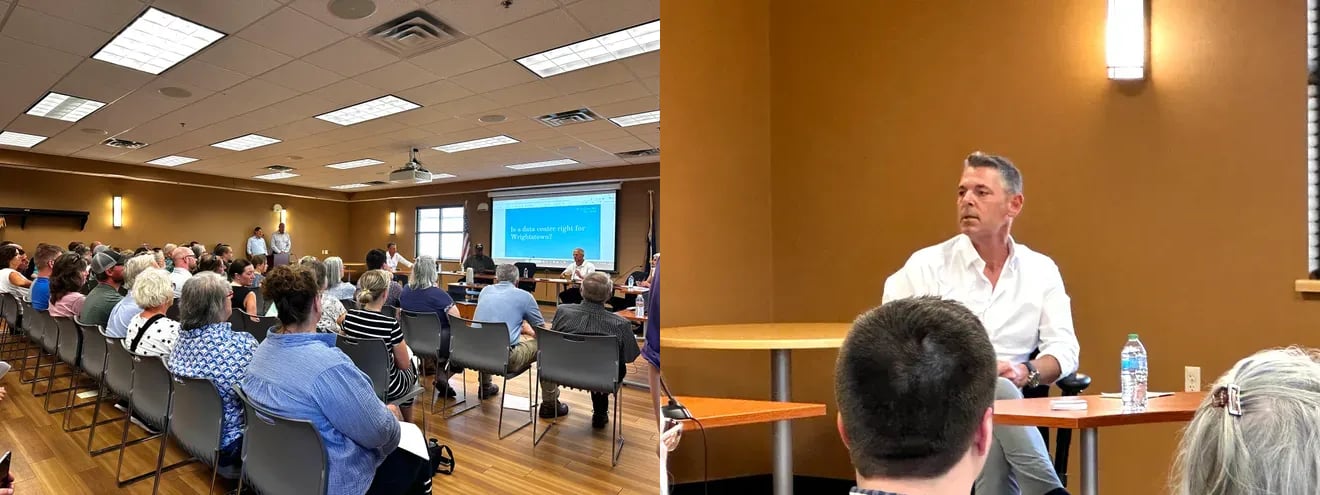
Cloverleaf Infrastructure has a practiced way of arriving in a community: quietly, through its officials, with a list of promises and no name on the tenant. It has a practiced way of leaving, too. Put the documented record end to end — Michigan, Illinois, Wisconsin, Georgia — and a clear picture emerges of the company now asking Lowndes County for thirty years of its tax base. This is that record.
Cloverleaf Infrastructure is a two-year-old company from Houston that has never built, owned, or operated a single data center.1 It assembles rural land, secures the power, and sells the finished package to a hyperscale operator. That is the entire business. And it is the company now asking the Lowndes County Commission to lock in a thirty-year property-tax abatement for a facility whose operator it will not name, on a clock set to beat a new state law.2
Put the documented record end to end and a method appears. Cloverleaf arrives quietly, through a community's own officials. It promises roads, schools, water, and prosperity. It will not say who the tenant is. And when residents organize, it leaves, only to surface again somewhere else, or in the same place under a different name. This is the file.
It does not operate. So its promises bind no one.
Every commitment Cloverleaf makes in Lowndes County belongs to Cloverleaf, not to the company that would actually own and run the data center. The water pledge, the jobs number, the road money, the promise that ratepayers will not be touched: none of it transfers to the eventual operator unless it is written into a contract designed to survive the sale.3 Cloverleaf has done this once for real and it is on the record. In Port Washington, Wisconsin, the company assembled and annexed the land, then handed the package to Vantage Data Centers for an eight-billion-dollar campus build.4 In Monroe County, Georgia, it operates behind a special-purpose entity named “Rum Creek DevCo LLC.”5 A Lowndes filing will likely wear a similar disposable name. The Commission is being asked to trust promises made by a party that intends to be gone before they come due.
“Community,” or “leadership”?
Cloverleaf has a written rule for where it will and will not build. In a September 2025 email to Michigan officials, released under that state's public-records law, a Cloverleaf development principal put the public-facing promise in writing.

That is the promise: the community decides. Then listen to what the same company says it actually looks for. At a Wrightstown, Wisconsin meeting, Cloverleaf's Chief Development Officer described the real test.
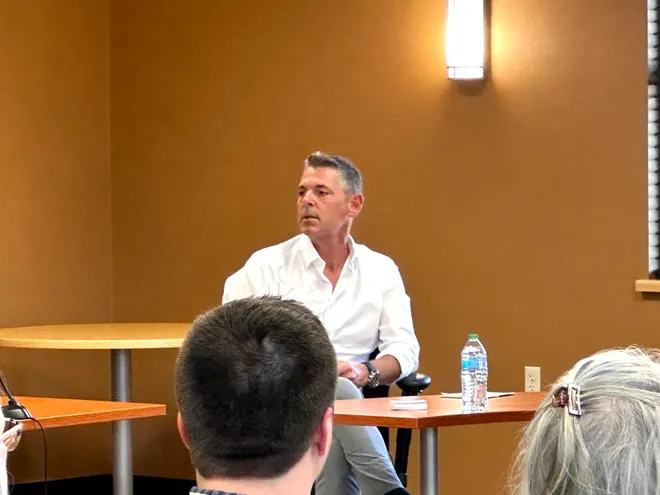
Read the two side by side. One says Cloverleaf will not build where the community does not want it. The other says what Cloverleaf actually requires is officials willing to facilitate. Those are not the same thing, and the gap between them is the whole game. A community can be overwhelmingly opposed and the project still moves, so long as a few leaders keep the conversations going.
The backroom: talk in secret, deny in public.
The facilitation happens out of sight. In Edwardsville, Illinois, the Illinois Answers Project obtained roughly two dozen emails through public records showing nearly a year of detailed Cloverleaf discussions with city officials about land surveys, special-use permits, road improvements, and engineering, while those same officials told residents on Facebook there was “no formal proposal.”8
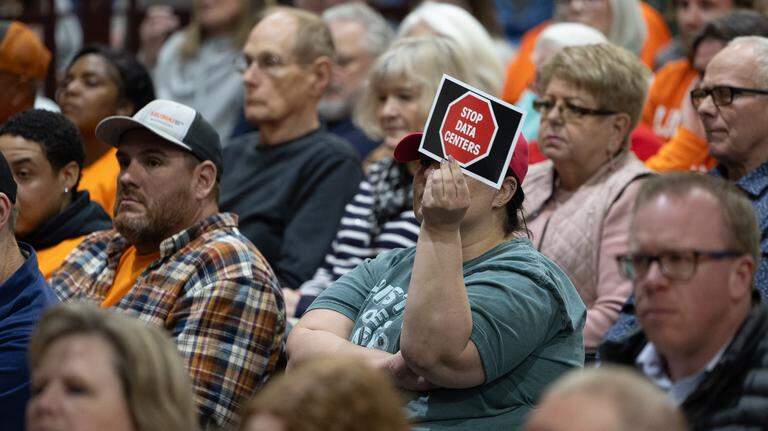
Wisconsin shows the same fingerprints. In Wrightstown, email records place the village administrator in talks with Cloverleaf beginning in January 2026, including a request for the facility location and a Zoom meeting, months before residents were told.9 One resident said the board had been “misleading” by withholding the communications. The administrator went so far as to request Cloverleaf's own zoning codes for a village “zoning code rewrite” — the developer effectively handed the pen to draft the local law it would later need.10
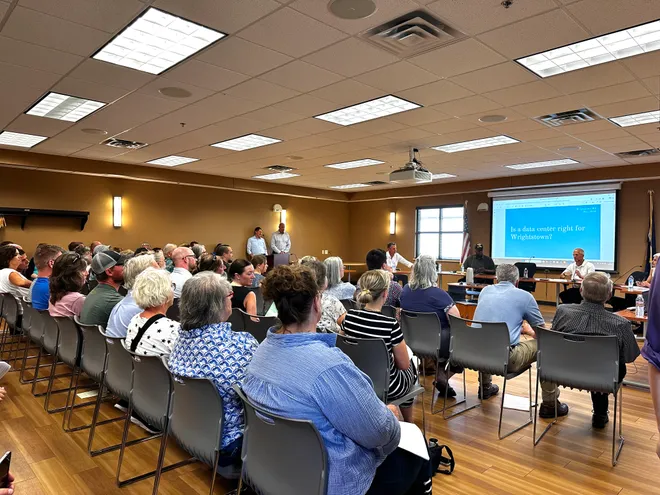
Lowndes County fits the template. Cloverleaf has worked through the Lowndes County Economic Development Commission, whose president sits on the water board that would serve the project and whose vice-president is the same Charlie King Jr. who chairs the County Commission that would vote on the abatement.11 The public learned the scope of the project not from a disclosure but by packing the rooms in opposition once word got out.12 File the public records requests now. The Edwardsville emails existed before anyone asked for them. So, almost certainly, do Lowndes's.
The promises, and the arithmetic.
The pitch is consistent because it is a script. In Wrightstown, Cloverleaf told residents data centers bring “significantly increased property values” that lead to better roads, better water and wastewater systems, better grid stability, and better schools.13 Lowndes is hearing the same lines. The arithmetic underneath is thinner. The campus is pitched at roughly fifty permanent jobs; independent local analysis estimates about nine would go to Lowndes residents.14 The headline ten-million- dollar community pledge is routed through a Montgomery foundation with no Lowndes resident on its board and is largely milestone-gated on conditions Cloverleaf controls.15 And the water claim — “basically the same as a small office building” — has a nearby precedent worth remembering: at the existing data center in Hope Hull, the public figure was thirty thousand gallons a day, while the actual contract allocated one hundred fifty thousand, plus ninety thousand gallons of wastewater.16 Five times the number the public was given.
The withdrawal that wasn't.
Lowndes has taken comfort in one fact: organized communities make Cloverleaf leave. It is true. Greenleaf, Wisconsin; Dundee Township, Michigan; Edwardsville, Illinois — each withdrew under pressure within seven months.1718 But Wisconsin also shows what a Cloverleaf withdrawal is worth. When the company quit Greenleaf in January 2026, its own statement named the next room it would enter: “After speaking to leadership at the Village of Greenleaf and the Town of Wrightstown, Cloverleaf will not be pursuing datacenters.”19 By spring, Cloverleaf was back, in Wrightstown, advancing a data center through a public referendum that asks voters to authorize utility infrastructure for large-scale data centers without naming any specific project.20 Same company. Same executive. Same promises. “Ten times out of ten” turns out to describe how Cloverleaf exits a room, not whether it returns to the building.
Who runs it.
We argue the platform, not personalities. But the public record of where Cloverleaf's leadership learned this work is relevant, because the patterns are the ones Lowndes is being asked to accept on faith.
- Cloverleaf's senior energy executive ran Microsoft's energy strategy from 2011 to 2023. During that period, The New York Times reported that Microsoft's Quincy, Washington data center burned electricity it did not need to avoid a roughly $210,000 fine for under-using committed power, alongside documented diesel-generator emissions.21
- Cloverleaf's Chief Development Officer previously ran land acquisition at Meta and, before that, Microsoft — the two hyperscalers most associated with confidentiality clauses on data-center water use. He is the executive who signed both the Greenleaf withdrawal and the Dundee acknowledgment that Cloverleaf “should have done more public communication and listening.”22
- Cloverleaf publicly states it is pursuing ten to fifteen gigawatts of peak capacity across all its sites. Lowndes is one node in a national pipeline, not a singular courtship.23
These are not character claims. They are the documented histories of the companies whose playbook Cloverleaf's leaders carried with them.
The money, and who really owns the deal.
Cloverleaf is backed by a roughly three-hundred-million-dollar raise from the private-equity firms NGP and Sandbrook Capital.24 In February 2026, Axios reported that Cloverleaf itself was drawing takeover interest.25 So the entity making promises to Lowndes County today may not be the entity that owns the project a year from now, which would sit on top of an operator that was never bound by those promises in the first place. Two layers of distance between the people making commitments and the people who would have to keep them.
What this means for Lowndes.
A withdrawal that only pauses the named project leaves every back door open: a renamed entity, a quieter round of meetings, an infrastructure vote that approves the road without naming the destination. That is why the Lowndes ask cannot stop at “not yet.” It has to be withdrawal, in writing, paired with closing the levers that let a project return — no thirty-year abatement, and no county or utility commitment to build the water and power infrastructure a hyperscale campus requires.26
It is also why the June 3 open house at Hayneville Middle School matters more than its come-and-go format suggests.27 The Wisconsin sessions were the template: a friendly room, no formal presentation, executives who will not name the site, and a list of promises. The residents of Wrightstown answered it the right way. They asked the questions Cloverleaf would not, and wrote down what it refused to say. Lowndes can do the same. The company already told one community it was finished, then came back. The only version of a win that holds is the one that closes the door behind it.