Cloverleaf Infrastructure has written down, on a date-stamped email to elected officials, exactly when the company says it walks away from a data-center project. The document was obtained through public records. The standard is unambiguous. By the company's own words, Lowndes County is the place Cloverleaf is supposed to leave alone.
The email.
On September 23, 2025, at 10:35 AM, Michael Evans, the Development Principal at Cloverleaf Infrastructure, sent a draft document titled “Cloverleaf vs. Other Developments” to three elected officials in Michigan: Roger Lewis, the Dundee Township Supervisor, plus Tim Bordine and Ryan Rudzis at the Village of Dundee. The email was copied to Aaron Bilyeu, Cloverleaf's Chief Development Officer.1
Months later, after Cloverleaf publicly withdrew the Michigan project, the document was released through the state's Freedom of Information Act. The provenance is unimpeachable. The author is senior. The audience is government. The release was obtained, not leaked. Cloverleaf cannot characterize the language as a junior misstep or an early-stage musing.
The test, in plain English.
Cloverleaf gave two reasons, in writing, for walking away from a site. Both are stated as company policy.
Test 1. Is the development unwelcome in the community?
If yes, Cloverleaf does not pursue it.
Test 2. Does the development match the existing use for the land?
If no, Cloverleaf does not pursue it.
The rule.
“That is a decision we will make ten times out of ten.” Not most of the time. Not when convenient. Ten times out of ten.
Lowndes County, against Cloverleaf's own standard.
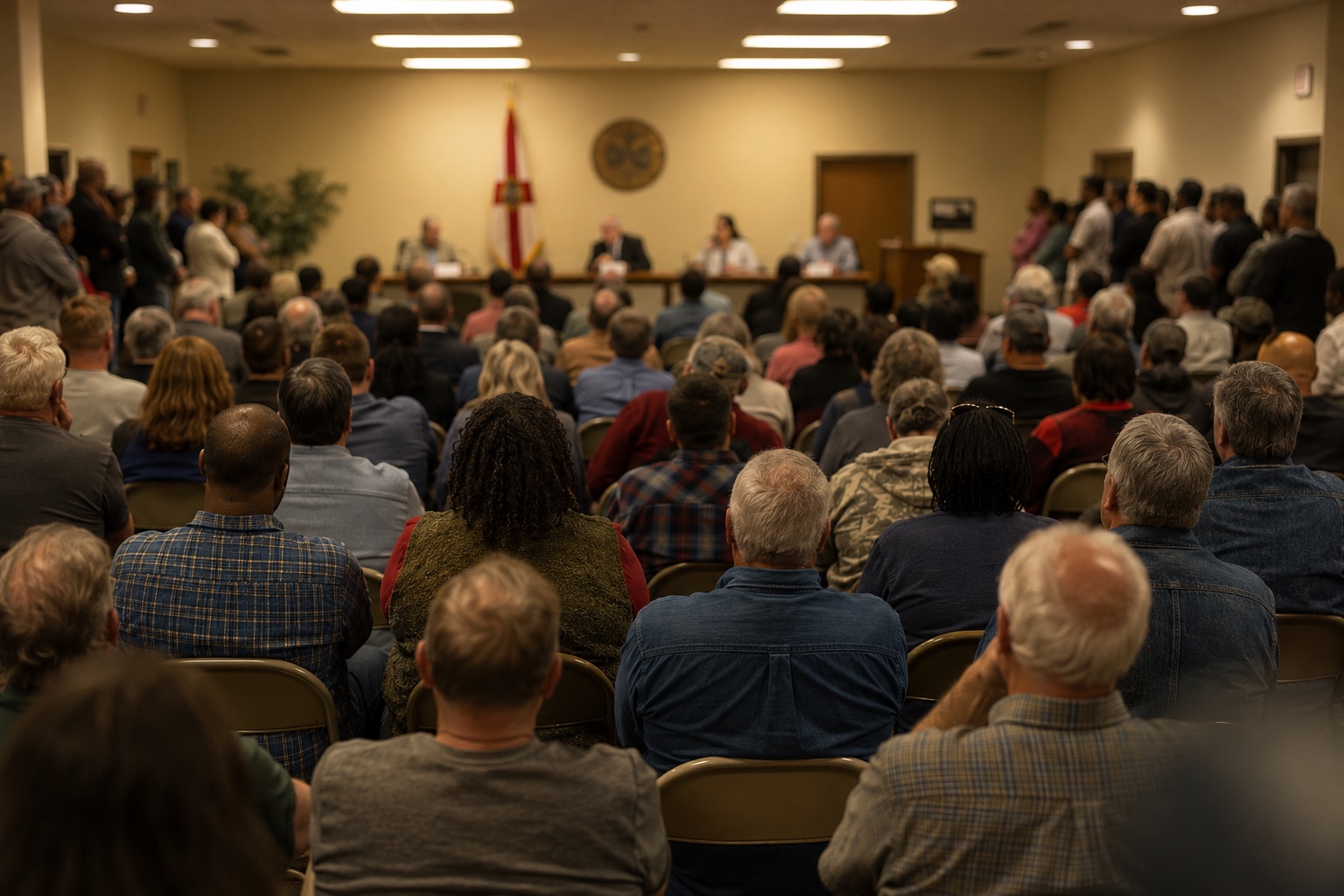
Test 1: Is Project Red Clay welcome in Lowndes? The opposition in Lowndes is organized, named (#45strong), public, and growing. A coalition meeting at the Highway 80 Cafe brought roughly one hundred residents out on under a week's notice.3 A subsequent Lowndes County Commission meeting at the Charles Smith Building filled to standing-room-only.4 Vice Chairman Dickson Farrior has moved in regular session to deny any tax abatement for any data center coming to Lowndes County; Commissioner Joey Barganier seconded.5 The Mayor of Lowndesboro has formally opposed the project in writing, on town letterhead, addressed to the full Commission. The municipal government inside the affected county is on record opposing this development. There is no ambiguity to interpret. The community is unwelcoming. Test 1 fails.
Test 2: Does the development match the existing use for the land? The proposed parcel sits on roughly 1,000 acres of rural, agricultural Black Belt land in a county whose existing uses are farmland, timberland, residential parcels, and the federally designated Historic Selma to Montgomery Civil Rights Trail.6 The proposed use is a 5-million-square-foot hyperscale industrial facility with 24-hour cooling load, backup diesel generation, and a new high-voltage interconnection.7 A data-center campus does not match the existing use for the land. Test 2 fails.
Both halves of Cloverleaf's own written standard fail in Lowndes County. By the company's own number, this is the place Cloverleaf walks away. They are proceeding anyway.
The policy has been honored before.
Three times in seven months, Cloverleaf has acted on the standard the company wrote down in Michigan.
Greenleaf, Wisconsin (January 2026). Bilyeu issued the formal withdrawal: “After speaking to leadership at the Village of Greenleaf and the Town of Wrightstown, Cloverleaf will not be pursuing datacenters.”8
Dundee Township, Michigan (October 2025). Cloverleaf publicly acknowledged the company “should have done more public communication and listening,” and dropped the project after the village council voted to block the water supply.9
Edwardsville, Illinois (March 2026). Cloverleaf withdrew after the Illinois Answers Project obtained roughly two dozen emails through the state's public-records law, showing nearly a year of detailed back-and-forth between Cloverleaf and city officials about land surveys, special-use permits, road improvements, and engineering, while city officials publicly told residents on Facebook there was “no formal proposal.”10
Lowndes County is the fourth public test of the same policy.
What to watch for in Lowndes.
The Edwardsville pattern is the one to watch most closely. The cycle there ran for nearly a year while elected officials told residents in writing that there was no formal proposal. Public records eventually proved otherwise. The same kind of paper trail almost certainly exists in Lowndes today, in the county and municipal email accounts of officials who have been meeting with Cloverleaf since at least the 2025 land-option negotiations.
A coordinated public-records request, modeled on the Edwardsville template, is the fastest way to make this verifiable. The full FOIA-style letter, with the eight categories of records most likely to expose the same pattern in Lowndes, is at /foia-template.
The question for Cloverleaf, and for the Commission.
If Cloverleaf intends to honor its own written standard, ten times out of ten means the project should be withdrawn from Lowndes County. The two-part test has been failed publicly, on the record, since at least the April 2026 community meetings that filled the rooms past capacity.
If Cloverleaf does not intend to honor that standard, the Lowndes County Commission has one clarifying question to ask before any abatement vote: which is Cloverleaf's actual policy. The one written to elected officials in Michigan in September 2025, or the one being executed in Lowndes today.