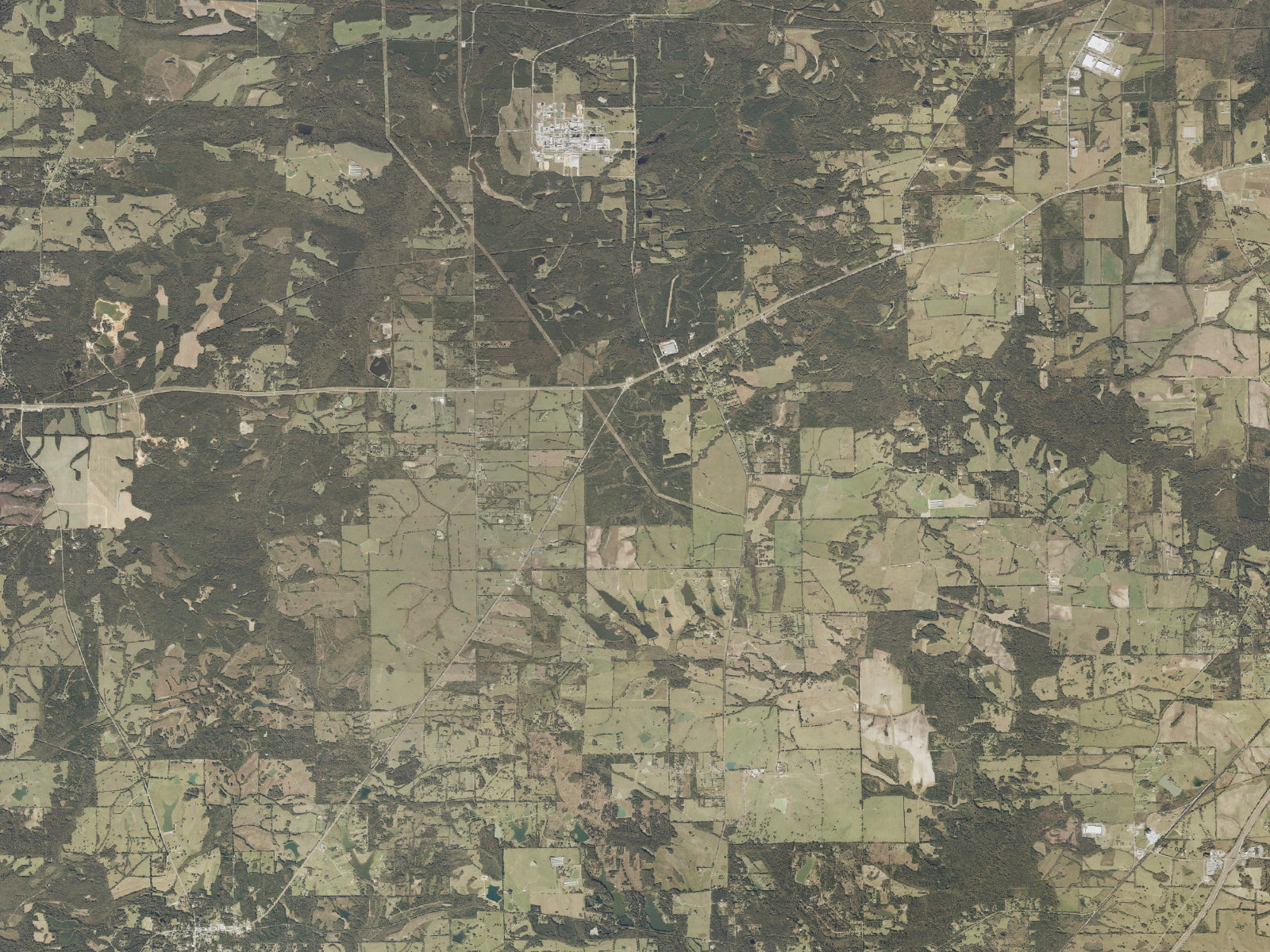
Cloverleaf Infrastructure's proposed 1,000-acre data center campus in Lowndes County is not being sited in some unmarked stretch of rural Alabama. It is being sited next door to the most consequential pedestrian protest in American history.
The geography.
The parcel Cloverleaf Infrastructure has under option for Project Red Clay sits on U.S. Route 80, the federally designated Historic Selma to Montgomery Civil Rights Trail.1 It is the road Dr. King walked in March 1965 with thousands of marchers on the way to the Alabama State Capitol. Today it is administered by the National Park Service and threads through some of the most consequential ground in American civil-rights history.
Robert Gardner's farm, the third of the march's four campsites, is roughly one mile from the proposed parcel. Rosie Steele's farm, the second campsite, sits further along the same trail.2
Pastor Franklin Nettles, of Calvary church, has spoken at coalition town halls and at the Lowndes County Commission. His church sits on the same U.S. 80 corridor that the proposed parcel sits on. Dr. Tom Gardner, of Beulah Primitive Baptist Church in Hope Hull, has also publicly spoken against Project Red Clay. Beulah Primitive Baptist Church is only 1.5 miles from the proposed site.3
And the closest neighbors are not at any of those landmarks. The proposed parcel sits adjacent to Windhaven Lakes, a 54-home subdivision whose nearest property lines are roughly 800 yards from the proposed site. Windhaven Lakes is the closest residential cluster to the parcel.4
Why the geography is the argument.
The Historic Selma to Montgomery Civil Rights Trail is not a memorial plaque. It is a working federal designation administered by the National Park Service, and it threads through a county where the documentary record on sanitation, water, and access to municipal infrastructure is among the most-cited in the country. The 2018 Earthjustice Title VI complaint, the 2017 visit by U.N. Special Rapporteur Philip Alston, the Baylor University finding that 34% of tested Lowndes residents were positive for hookworm. Those are not ancient grievances. They are the still-operating context into which a Houston-based startup wants to drop a billion-dollar industrial load.6
Faith in Action annually buses pastors, business leaders, and college students into Lowndes County for commemorations of the march. The route passes within sight of the proposed parcel. Cloverleaf's own messaging has avoided mentioning this geography. Reporters covering the project have noticed.7
What Cloverleaf has said about the site.
On the public record, Cloverleaf has described Project Red Clay as a clean-power-anchored campus that would coexist quietly with its neighbors. Aaron Bilyeu, Cloverleaf's Chief Development Officer and the executive who came directly from running land acquisition at Meta, has told residents the facility's cooling will be “closed-loop,” comparable, in his words, to “the same as a small office building.”8
That phrase has done a lot of work for the developer in early public meetings. It is also not how the rest of the hyperscale industry describes a campus of the size described to residents. Industry reporting documents typical hyperscale water draws at three to seven million gallons per day at peak, and the nearest live comparable, Meta's Hope Hull facility twelve miles away, is already the single largest customer in the Montgomery water system.910
The Cloverleaf two-part test.
Cloverleaf has written, on its own letterhead, what its test is for whether a community is a fit for one of its data-center projects. In a September 2025 email to officials in Dundee, Michigan, released through Michigan's public-records law, Cloverleaf development principal Michael Evans wrote that the company would not pursue projects in “communities where this type of development is unwelcome” or where the “existing use for the land” was inconsistent with industrial conversion.11
Both halves of that test fail in Lowndes County. The opposition is organized, named (#45strong), public, and growing. The existing use of the land is rural and agricultural, the heart of Alabama's Black Belt. By Cloverleaf's own stated standard, this is not the right place. They are proceeding anyway.
The question for reporters, and for the Commission.
The question is not whether Lowndes County should have economic development. It is whether this economic development (sited one mile from a campsite on the Historic Selma to Montgomery Civil Rights Trail, drawing from water and power infrastructure that the county does not have in surplus, structured to grandfather under a 30-year tax abatement before a unanimous state law caps that window at 20) is the development that Lowndes County's leadership wants on its permanent record.
Cloverleaf has walked away from organized opposition in three states in seven months.1213 Each time, the deciding factor was a community that organized in public and a local government that did not vote yes. Lowndes County is the next test of that pattern.